Brand prices, generic options, insurance costs, and practical ways to pay less in the United States
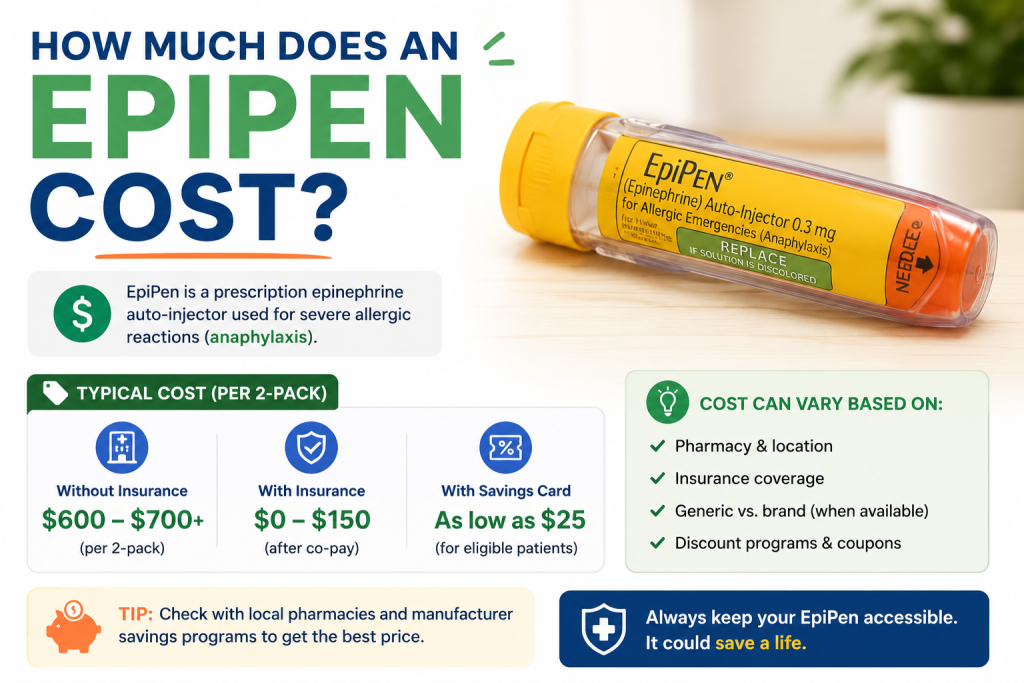
| August 2026 price snapshot A brand-name EpiPen 2-Pak can still carry a retail price near $650 to $750 before insurance or discounts. Generic and authorized-generic epinephrine auto-injectors are often available for roughly $175 to $300 per two-pack when a current pharmacy coupon is used. Your actual cost may be much lower with insurance or a manufacturer program. |
The question “how much does an EpiPen cost?” sounds as though it should have one simple answer. In practice, the number at the pharmacy can change by hundreds of dollars depending on the product written on the prescription, the pharmacy, the insurance formulary, the deductible, and whether a savings card or cash coupon is used.
EpiPen is a brand name for an epinephrine auto-injector. Many people use the name for all emergency epinephrine devices, but the brand, authorized generic, FDA-approved generics, and competing devices do not necessarily have the same price or the same operating steps. That distinction matters when comparing costs.
Key Takeaways
- A brand-name EpiPen 2-Pak may retail for about $650 to $750 without insurance, although the price at a specific pharmacy can be higher or lower.
- Generic or authorized-generic epinephrine auto-injectors commonly fall near $175 to $300 for a two-pack with a current discount coupon.
- Commercial insurance can reduce the cost to a low copay, but a deductible, coinsurance, or nonpreferred formulary tier may leave a much larger bill.
- Eligible commercially insured patients may qualify for an EpiPen savings card worth up to $300 per carton, subject to current program terms.
- Do not choose a device based only on price. Make sure the prescription, dose, training, and device design are appropriate for the person who will use it.
The EpiPen Price Ladder: What Might You Actually Pay?
The most useful way to understand the cost is to separate the sticker price from the final out-of-pocket price. The ranges below are national estimates and discount snapshots, not guaranteed pharmacy quotes.
| Payment route | Typical 2026 range | What changes the price | Best first step |
| Brand EpiPen, no insurance | About $650 to $750 per 2-Pak before discounts | Pharmacy, ZIP code, supply, and coupon availability | Compare the brand price with the authorized generic before paying |
| Generic or authorized generic, cash coupon | Often about $175 to $300 per two-pack | Manufacturer, pharmacy, strength, and coupon code | Ask the prescriber to permit an appropriate generic and compare pharmacies |
| Commercial insurance | $0 or a low copay for some plans, but potentially hundreds with a deductible | Formulary tier, deductible, coinsurance, prior authorization | Check the exact National Drug Code or product name with the insurer and pharmacist |
| Medicare or Medicaid | Plan and state specific | Covered product, tier, deductible, and program rules | Use the plan formulary and ask about the preferred epinephrine product |
| Manufacturer assistance | Potentially much lower, including free medicine for some eligible patients | Insurance type, income, residency, and program limits | Review official eligibility rules before the prescription is filled |
Why Can the Same EpiPen Prescription Produce Two Very Different Bills?
The price shown in an online search is not always the amount that an insured patient pays. Pharmacies can process the prescription through an insurance plan, a manufacturer savings card, or a prescription discount program. Those routes use different negotiated prices and usually cannot be stacked together.
1. Brand Versus Generic Wording
A prescription written specifically for brand EpiPen may be processed differently from one that allows generic substitution. Viatris sells an authorized generic that uses the same drug and device design under an epinephrine label rather than the EpiPen name. Other FDA-approved generic epinephrine auto-injectors may also be available, but devices can differ in appearance and instructions.
2. The Insurance Formulary
An insurance company may prefer one epinephrine product and place another on a higher tier. A preferred generic might have a small copay, while brand EpiPen may require prior authorization or full payment until a deductible is met. The cheapest retail product is not always the cheapest insured product, so both prices should be checked.
3. Pharmacy and ZIP Code
Cash and coupon prices can vary among pharmacies in the same city. Discount prices also change over time. A price found several months ago may not be honored at the next refill, which is why it is important to run a new comparison for the correct strength and quantity before every purchase.
4. Dose and Package Size
EpiPen 0.3 mg is generally used for people who weigh 66 pounds or more, while EpiPen Jr 0.15 mg is generally used for people who weigh 33 to 66 pounds. The prescription is usually filled as a carton containing two single-use devices. Comparing a one-device figure with a two-pack price can make one option appear cheaper than it actually is.
How Much Is EpiPen Without Insurance?
A patient paying the full brand-name retail price may see a bill around $650 to $750 for an EpiPen 2-Pak. This is the high end of the market and should not be treated as the only available price. Before paying, ask the pharmacist to quote the authorized generic and any FDA-approved generic listed on the prescription.
Current discount listings often place generic epinephrine near $175 to $300 per two-pack, with some widely available coupon prices around the mid-$170s. These numbers can move from week to week. The most reliable approach is to compare the exact prescription at nearby pharmacies on the day it will be filled.
For a live local comparison, check the current GoodRx epinephrine auto-injector price page and confirm the displayed product, strength, quantity, manufacturer, and pharmacy before presenting the coupon.
How Much Does EpiPen Cost With Insurance?
There is no universal insured price. A person whose plan treats generic epinephrine as a preferred drug may pay nothing or a modest copay. Another person with a high-deductible plan may pay most of the negotiated price early in the year. Coinsurance can also create a percentage-based charge rather than a fixed copay.
Before the prescription is sent, call the insurer or use its online drug-price tool. Ask which epinephrine auto-injector is preferred, whether prior authorization is required, what the two-pack will cost at a retail pharmacy, and whether a mail-order option is allowed. Give the prescriber the preferred product name so the pharmacy does not have to restart the process after a rejection.
Can an EpiPen Savings Card Lower the Cost?
Viatris currently offers savings programs for brand EpiPen and its authorized generic. Eligible commercially insured patients may save up to $300 on each EpiPen or EpiPen Jr 2-Pak carton, with use limits that apply during the calendar year. The authorized-generic card has a smaller maximum benefit. Program terms can change, and government-funded insurance such as Medicare, Medicaid, and TRICARE is generally excluded from manufacturer copay cards.
Review eligibility and current limits on the official EpiPen access and savings programs page before relying on a coupon amount shown on an older article or saved image.
People without prescription coverage or with financial hardship may also qualify for the Viatris Patient Assistance Program. Approval is not automatic. The program may require proof of U.S. residence, income information, a valid prescription, and participation by the healthcare professional.
Are Cheaper EpiPen Alternatives the Same Thing?
Every emergency epinephrine product delivers epinephrine, but the devices are not interchangeable in the everyday sense. The cap, needle end, activation method, hold time, voice prompts, dose options, and storage instructions can differ. A lower price is helpful only when the patient and caregivers know exactly how to use that device.
| Option | Potential cost advantage | Important distinction |
| Authorized generic EpiPen | Often much less than the brand cash price | Same drug and device design under a generic label |
| Other generic epinephrine auto-injectors | Coupon prices may compete with or beat the authorized generic | Instructions may differ, so retraining is essential |
| AUVI-Q | Most commercially insured patients may pay $35 or less; other program limits apply | Compact device with voice instructions and different dose options |
| neffy nasal spray | Eligible commercially insured patients may pay as little as $0 under current terms | Prescription nasal epinephrine, not an auto-injector; coverage and clinical suitability vary |
A prescriber may need to issue a new prescription when changing to another device. Ask the pharmacist for a trainer or demonstration and make sure family members, school staff, and caregivers are familiar with the product that was actually dispensed.
A Five-Minute Cost Check Before You Fill the Prescription
- Read the prescription name and dose. Confirm whether it says brand EpiPen, epinephrine auto-injector, EpiPen Jr, or another device.
- Check the insurance formulary. Find the preferred product and estimated cost for a two-device carton.
- Compare the insurance price with a cash coupon. A coupon may be cheaper, but purchases outside insurance may not count toward the deductible.
- Check the manufacturer program. Confirm eligibility, annual limits, expiration, and whether commercial insurance is required.
- Call the pharmacy. Ask whether the exact product is in stock and whether the quoted price matches the National Drug Code they will dispense.
- Ask for training. Switching devices to save money should always include updated instructions and practice with a trainer.
What Should Families Budget for Multiple Locations?
The cost can multiply when a child or adult needs epinephrine at home, school, work, daycare, or during travel. However, separating a two-pack may conflict with the instruction to keep two doses available because a second dose can be needed before emergency help arrives. Discuss the number of cartons needed with the prescriber rather than deciding solely on price.
Schools may stock undesignated epinephrine under state laws and local policies, but families should not assume the school supply replaces the student’s personal prescription. Ask the school nurse what is stocked, where it is kept, who may administer it, and whether a current individual action plan is required.
Do EpiPens Expire, and Does Replacement Affect the Annual Cost?
Epinephrine auto-injectors have expiration dates and must be replaced. Keep the devices at room temperature, protect them from light and extreme heat or cold, and inspect the solution when the device has a viewing window. A device that is expired, damaged, discolored, or contains particles should be replaced.
Because refills are recurring, the annual cost may include more than one carton. Set reminders several weeks before expiration so there is time to request a new prescription, compare prices, obtain prior authorization, and locate stock. Do not wait until the last device expires to begin the process.
Cost Should Never Delay Emergency Treatment
Epinephrine is the first-line emergency treatment for anaphylaxis. Use the prescribed device promptly when a serious allergic reaction is suspected, then follow the emergency plan and obtain medical help. Do not save a device for later because it was expensive.
The MedlinePlus epinephrine injection guide advises keeping two automatic injection devices available because one dose may not be enough. It also explains that epinephrine does not replace emergency medical care.
Frequently Asked Cost Questions
Is a Generic EpiPen as Effective as the Brand?
FDA-approved generic epinephrine auto-injectors must meet applicable standards for safety, effectiveness, quality, and device performance. An authorized generic EpiPen uses the same drug and device design as the brand product. Still, the label and appearance can differ, and another manufacturer’s device may use different operating steps.
Can I Use Insurance and a GoodRx Coupon Together?
Usually, no. The pharmacy generally processes the prescription through either insurance or the discount coupon. Compare both prices before choosing. A cash coupon purchase may not count toward an insurance deductible or out-of-pocket maximum.
Why Did the Pharmacy Price Change Since My Last Refill?
Discount contracts, pharmacy pricing, product availability, insurance formularies, and deductibles can change. Always generate a new coupon and reconfirm the exact product before each refill instead of relying on a screenshot from the previous purchase.
Can I Buy One EpiPen Instead of a Two-Pack?
EpiPen is commonly packaged as two auto-injectors, and official instructions emphasize carrying two because a second dose may be required. Ask the prescriber and pharmacist about available packaging, but do not separate devices in a way that leaves the patient without a backup dose.
What Is the Most Affordable Option?
There is no single winner for every patient. A preferred generic through insurance may be cheapest for one family, while an EpiPen savings card, an AUVI-Q access program, or a cash coupon may be better for another. The best choice combines affordability, coverage, availability, correct dosing, and confidence using the device.
The Bottom Line
In 2026, a brand EpiPen 2-Pak can still cost roughly $650 to $750 before insurance or discounts. Generic and authorized-generic epinephrine auto-injectors are commonly available for about $175 to $300 with a current coupon, and some insured patients pay far less. Manufacturer savings and patient assistance may lower the price further for eligible patients.
The smartest way to reduce the bill is to compare the insurer’s preferred product, the current cash coupon price, and official manufacturer assistance before the prescription is filled. Any switch should be approved by the prescriber and followed by device-specific training. Price matters, but immediate access to two usable doses matters more.
| Medical note: This article provides general U.S. pricing and educational information as of August 2026. Pharmacy prices, coupons, insurance benefits, and assistance programs can change. It does not replace advice from a physician, pharmacist, allergist, or emergency professional. |