
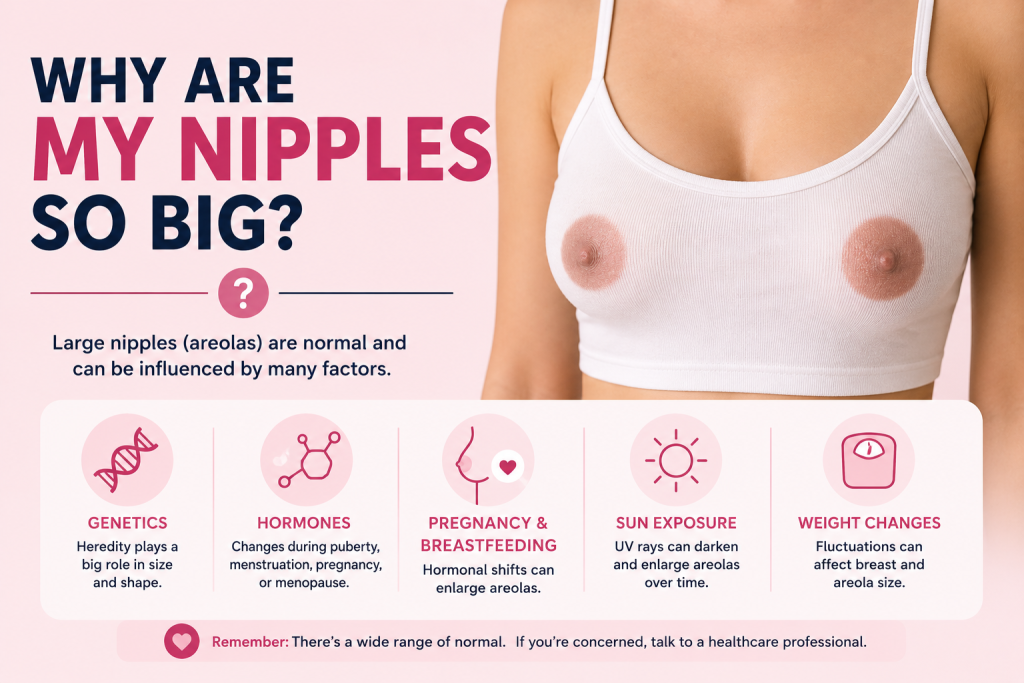
Nipples and areolas vary widely, so if you are asking why are my nipples so big, the most useful clues are whether the appearance is normal for you, whether it changed recently, and whether other breast symptoms appeared at the same time.
The first step is to identify which part looks larger. The nipple is the raised or flat structure in the center of the breast. The areola is the circular area of darker or differently colored skin surrounding it. Many people who are concerned about “large nipples” are actually noticing large areolas.
Both nipple and areola size vary naturally from person to person. Genetics, breast size, puberty, hormonal changes, pregnancy, breastfeeding, weight changes, aging, and benign breast conditions can all affect how the nipple-areola complex looks. One side can also be slightly different from the other without signaling a health problem.
Cleveland Clinic notes in its nipple anatomy guide that nipple appearance varies from person to person. Nipples can protrude, lie flat, or point inward, and the surrounding areola is a separate structure whose size and color also vary widely.
| KEY TAKEAWAYS
· There is no single “correct” nipple or areola size. Normal anatomy has a broad range. · If the nipple-areola area has always looked large and both sides are otherwise healthy, it is usually normal variation. · Puberty, pregnancy, breastfeeding, menstrual hormones, weight changes, and breast growth can make nipples or areolas look larger. · In males, gynecomastia or increased chest fat can make the nipple and areola look wider or puffier. · A recent one-sided change deserves more attention than a stable lifelong difference. · New nipple inversion, bloody or spontaneous discharge, a lump, skin dimpling, persistent scaling, or redness should be evaluated by a healthcare professional. |
First, Are You Looking at the Nipple or the Areola?
| Part | What It Is |
| Nipple | The central structure that may protrude, lie flat, or turn inward. It contains small openings for milk ducts. |
| Areola | The circular pigmented skin around the nipple. It can be small, large, round, oval, light, dark, smooth, or bumpy. |
| Montgomery glands | Small oil-producing glands in the areola that can look like tiny bumps and may become more noticeable with hormonal changes. |
This distinction matters because an areola can expand as the breast grows even when the central nipple has barely changed. Darker pigmentation can also make an areola seem visually larger than it is.
Is There a Normal Nipple Size?
There is a wide normal range rather than one ideal measurement. Cleveland Clinic reports an average nipple width of about 10 to 12 millimeters, but an individual nipple can be smaller or larger and still be healthy. Appearance also changes with temperature, touch, hormonal shifts, and sexual arousal because smooth muscle in the nipple can contract.
Areola size varies even more. People with larger breasts often have larger areolas, but breast size does not perfectly predict areola size. Two healthy people of the same age and body size can have very different nipple and areola proportions.
Symmetry is also not required. One breast, nipple, or areola may be somewhat larger than the other. A stable difference that has been present for years is generally less concerning than a new change.
Why Can Nipples or Areolas Look Bigger Over Time?
Puberty and Normal Breast Development
During puberty, rising hormones stimulate breast tissue and the duct system to grow. Johns Hopkins Medicine notes that the areola becomes larger as breast development progresses. The two breasts do not always develop at exactly the same speed, so temporary asymmetry is common.
Pregnancy and Breastfeeding
Pregnancy can cause some of the most noticeable changes. The breasts enlarge, areolas often become wider and darker, nipples may become more prominent, and Montgomery glands can become easier to see. These changes help prepare the breast for feeding.
After pregnancy and breastfeeding, the nipple-areola area may move back toward its previous appearance, but it does not always return to exactly the same size or color. Persistent changes after pregnancy can still be normal.
Menstrual Hormone Changes
Hormonal shifts during the menstrual cycle can make breasts feel fuller, swollen, or tender. The change is usually temporary and affects both breasts. Some people notice that nipples feel more sensitive or look more prominent before a period even if the actual tissue size has changed very little.
Weight Gain or Weight Loss
Breasts contain a substantial amount of fatty tissue. When breast volume increases with weight gain, the skin and areola may stretch and look larger. Weight loss can make the areola appear relatively different as breast volume changes, although the skin does not always shrink in perfect proportion.
Genetics and Natural Proportions
Some people simply have larger nipples or areolas from adolescence onward. Genetics influence breast size, skin pigmentation, tissue distribution, and the proportions of the nipple-areola complex. If your appearance has been stable and there are no other symptoms, size alone is not usually a sign of disease.
Montgomery Glands and Areola Bumps
The small bumps on the areola are often Montgomery glands, not abnormal growths. Cleveland Clinic explains that these glands release oil that protects the nipple and areola. They can become more noticeable during pregnancy and breastfeeding, but their number and visibility vary even outside those life stages.
A single gland can occasionally become blocked or inflamed. A tender red bump that behaves like a pimple may need simple local care or medical evaluation if it persists, worsens, or appears infected.
What If You Are Male and the Nipple Area Looks Larger or Puffy?
In boys and men, a larger or puffier nipple-areola area can be related to gynecomastia, which is an increase in glandular breast tissue. It is common during puberty and can also occur in adulthood when the balance between testosterone and estrogen changes.
Extra chest fat can produce a similar appearance without true gland enlargement. Medications, alcohol, anabolic steroids, certain health conditions, and normal aging can also contribute to gynecomastia.
A clinician should evaluate a new firm lump, nipple discharge, skin dimpling, significant pain, or a one-sided change that is clearly different from the other side.
The Most Useful Question: Has It Always Looked This Way?
Timing is often more informative than size itself.
| Pattern | What It Suggests |
| Large for as long as you remember | Usually normal anatomy, especially if both sides are stable and there are no other symptoms |
| Gradually changed during puberty | Usually part of normal breast development |
| Changed during pregnancy or breastfeeding | Usually hormone-related and expected |
| Changed with major weight gain or loss | Often related to changes in breast volume and skin stretch |
| Suddenly changed on one side | Worth medical evaluation, especially with discharge, a lump, redness, or skin change |
| Nipple newly pulling inward | Needs evaluation because new retraction can have several causes, including breast disease |
Can Large Nipples or Areolas Be a Sign of Breast Cancer?
Size by itself is not a typical breast cancer warning sign. Most nipple and areola differences are benign. What matters more is a new change in appearance or a new symptom involving one breast.
The National Cancer Institute advises getting unusual breast changes checked, including new nipple flattening or direction changes, non-milk discharge, swelling, redness or darkening, scaling, itching, dimpling, or a new lump.
These signs do not automatically mean cancer. Infections, eczema, hormonal conditions, blocked ducts, cysts, and other benign problems can create similar changes. The reason to see a clinician is that appearance alone cannot reliably distinguish every cause.
What Does Paget Disease of the Breast Look Like?
Paget disease is a rare form of breast cancer that involves the nipple and usually the areola. It is not simply an enlarged nipple.
Typical warning signs include persistent redness, itching, tingling, crusting, flaking, or thickened skin on or around the nipple. The nipple may flatten, and discharge can be yellowish or bloody. These symptoms can resemble eczema, which is why a persistent one-sided nipple rash should be evaluated rather than repeatedly treated at home without a diagnosis.
When Should You See a Doctor About a Nipple or Areola Change?
Make an appointment if a nipple or areola changes noticeably without an obvious explanation, particularly if the change is new and affects only one side.
- A new lump in the breast or underarm.
- Spontaneous nipple discharge, especially if bloody or clear and coming from one side.
- A nipple that newly becomes inverted, flattened, or points in a different direction.
- Persistent redness, scaling, crusting, ulceration, or itching of the nipple or areola.
- Skin dimpling, puckering, or an orange-peel texture.
- Rapid swelling, warmth, significant tenderness, or fever that could suggest infection.
- A recent one-sided size or shape change that continues to progress.
If you notice a rapidly growing breast, significant redness and warmth, fever, severe pain, or signs of a serious infection, seek prompt medical care rather than waiting for a routine visit.
How Does a Clinician Evaluate a Nipple or Areola Change?
Evaluation usually starts with the history of the change. A clinician may ask when it began, whether it affects one or both sides, whether there is pain or discharge, whether you are pregnant or breastfeeding, what medicines you use, and whether there is a family history of breast or ovarian cancer.
A physical breast exam may be all that is needed for an obvious benign variation. If the change is new or suspicious, the next step can include ultrasound, diagnostic mammography, or other imaging depending on age, sex, symptoms, and breast tissue. Persistent skin changes may require dermatologic evaluation or a biopsy.
The goal is not to test every large nipple. It is to investigate changes that do not fit your usual anatomy or that appear with other warning signs.
Can You Make Nipples or Areolas Smaller?
There is no proven cream, exercise, massage, or supplement that reliably shrinks a naturally large nipple or areola.
If size is purely a cosmetic concern and it causes significant distress, plastic surgery can reduce nipple projection or areola diameter. These procedures can leave scars and may affect nipple sensation or breastfeeding ability, depending on the technique. Anyone considering surgery should discuss future pregnancy and breastfeeding plans with a board-certified plastic surgeon.
Cosmetic treatment is optional. A large nipple or areola does not need correction simply because it falls outside an average measurement.
Frequently Asked Questions
Why are my areolas suddenly bigger?
Pregnancy, hormonal changes, breast growth, weight changes, and temporary swelling can make areolas appear larger. A new one-sided change, especially with a lump, discharge, rash, or nipple retraction, should be evaluated.
Why are my nipples puffy?
Puffiness can come from normal anatomy, hormonal changes, breast swelling, gynecomastia in males, or changes in the tissue beneath the areola. Persistent one-sided swelling or a firm lump deserves medical review.
Is it normal for one nipple to be bigger than the other?
Yes. Mild asymmetry is common. A stable difference that has always been present is generally less concerning than a new change in one nipple or breast.
Do nipples get bigger with pregnancy?
They often become more prominent, and the areolas commonly become larger and darker as breast tissue prepares for breastfeeding.
Can weight gain make areolas larger?
Yes. If breast volume increases, the skin and areola can stretch. Weight loss may change the proportions again, but the skin may not return exactly to its previous appearance.
Are bumps on the areola normal?
Often, yes. Montgomery glands are normal oil-producing glands that can look like small bumps. A painful, red, draining, or enlarging bump should be checked if it does not settle.
Are large nipples a sign of breast cancer?
Large size alone is not a typical sign. Cancer concern is higher with a new nipple change, a lump, spontaneous discharge, skin dimpling, persistent scaling or crusting, or new inversion.
The Bottom Line
Large nipples or areolas are usually a normal body variation, especially when they have looked that way for years and both breasts are otherwise healthy. Puberty, pregnancy, breastfeeding, hormones, weight changes, genetics, and changes in breast volume can all alter how prominent the nipple-areola complex appears.
The key is not whether your anatomy matches an average measurement. It is whether something has changed. A recent one-sided change, new inversion, discharge, a lump, persistent rash, dimpling, or swelling deserves medical evaluation.
If the concern is appearance alone and there are no warning signs, there is usually no medical need to change nipple or areola size.
This article provides general educational information and is not a diagnosis or substitute for individualized medical care. Breast and nipple changes should be assessed by a qualified healthcare professional when they are new, persistent, or accompanied by other symptoms.