
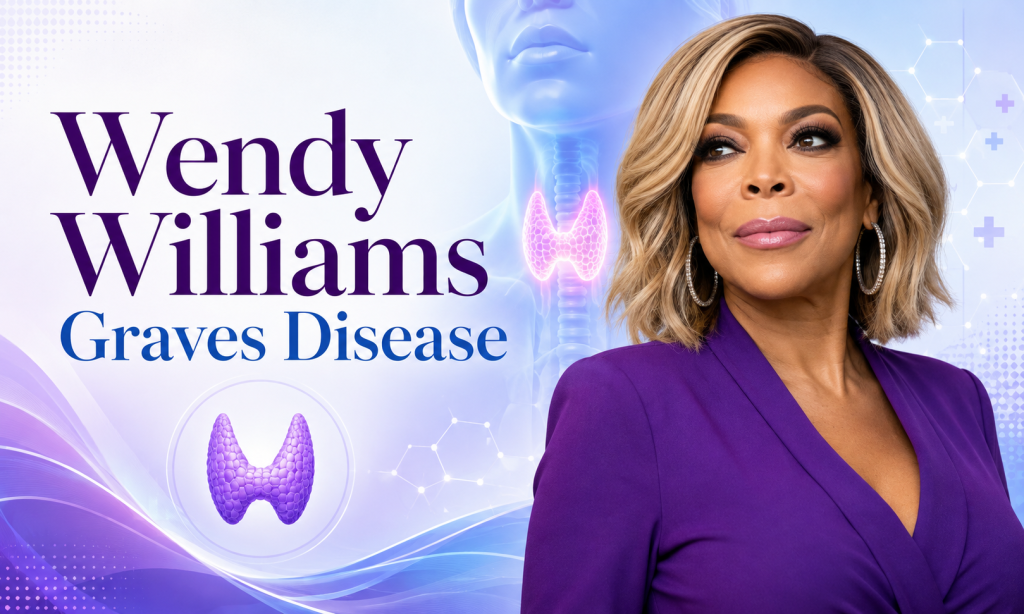
An evidence-based look at the thyroid condition she discussed publicly, the symptoms that can be missed, and the limits of diagnosing anyone through headlines or appearance.
The phrase Wendy Williams Graves disease became widely searched after the television host told viewers in 2018 that she was living with Graves’ disease and hyperthyroidism. Her disclosure brought unusual public attention to an autoimmune thyroid disorder that can affect heart rate, sleep, mood, weight, muscles, eyes, and day-to-day stamina.
Her story is useful as an awareness starting point, but it is not a medical chart. Public appearances cannot show whether Graves’ disease is active, in remission, controlled by medication, or connected to any later health development. The safest way to understand the condition is to separate verified public statements from general medical facts.
| Key Takeaways
Wendy Williams publicly disclosed Graves’ disease and hyperthyroidism in 2018. Graves’ disease is an autoimmune cause of an overactive thyroid, not simply a “fast metabolism.” Symptoms can affect many body systems and may be mistaken for stress, menopause, anxiety, or overwork. Treatment may involve antithyroid medication, radioactive iodine, surgery, and symptom control. Eye disease can follow a different course from thyroid hormone levels. Her current thyroid status is private and cannot be determined from media coverage. |
The Public Moment That Changed the Conversation
On February 21, 2018, Williams announced on her daytime program that she had Graves’ disease and hyperthyroidism and would take a medically recommended break. Contemporary reporting noted that her team said she had been dealing with Graves’ disease for years. ABC News documented that announcement, including her description of thyroid-related eye changes and the need to get her medication and hormone levels back in balance.
That disclosure mattered because Graves’ disease often looks nonspecific from the outside. A person may be exhausted but unable to sleep, lose weight while eating normally, feel overheated, experience a racing heartbeat, or become unusually irritable. Those changes can be explained away as work stress or aging until blood tests reveal an overactive thyroid.
What Is Publicly Known, and What Is Not?
| Supported by public reporting | Not possible to conclude from public reporting |
| Williams said she had Graves’ disease and hyperthyroidism. | Whether her Graves’ disease is currently active, controlled, or in remission. |
| She publicly connected eye changes and a need for medical leave with her thyroid condition. | Whether any later symptom, diagnosis, or career event was caused by Graves’ disease. |
| She has also separately discussed lymphedema. | That lymphedema and Graves’ disease are the same condition or have the same cause. |
Graves’ Disease Is an Immune Signal Problem
The thyroid is a small gland at the front of the neck, but its hormones influence nearly every organ. In Graves’ disease, the immune system produces antibodies that act like a stuck accelerator. These antibodies stimulate the thyroid to release more hormone than the body needs. The result is hyperthyroidism, a state in which many body processes run too fast.
The National Institute of Diabetes and Digestive and Kidney Diseases estimates that Graves’ disease affects nearly 1 in 100 Americans and causes about 4 out of 5 cases of hyperthyroidism in the United States. It is more common in women and in people older than 30, although it can occur at other ages.
The “Signal Map”: How an Overactive Thyroid Can Show Up
| Body system | Possible signs | Why it may be overlooked |
| Heart and circulation | Fast pulse, pounding heartbeat, irregular rhythm, higher blood pressure | May be blamed on caffeine, panic, or poor conditioning |
| Nervous system | Tremor, nervousness, restlessness, irritability, trouble sleeping | May resemble anxiety or chronic stress |
| Metabolism | Weight loss, heat intolerance, sweating, increased appetite | Weight change may be welcomed instead of investigated |
| Muscles and bones | Weakness, fatigue, reduced exercise tolerance, bone loss over time | Fatigue may be blamed on age or a busy schedule |
| Digestive and reproductive systems | Frequent bowel movements, menstrual changes, fertility concerns | Symptoms may be treated separately |
| Eyes | Dryness, grittiness, swelling, light sensitivity, bulging, double vision | Eye symptoms may be mistaken for allergies or lack of sleep |
Why Did Her Eyes Become Part of the Discussion?
Graves’ disease can affect tissue around the eyes, producing thyroid eye disease, also called Graves’ ophthalmopathy. This is not simply a cosmetic change. Inflammation can cause dry or gritty eyes, eyelid swelling, pressure, light sensitivity, bulging, pain with eye movement, or double vision. Rarely, severe swelling can threaten vision.
The eye condition and the thyroid condition are related, but they do not always move together. Eye symptoms can begin before hyperthyroidism is diagnosed, appear during treatment, or continue after thyroid hormone levels normalize. Smoking and nicotine exposure are especially important because they increase the risk and severity of thyroid eye disease.
| Urgent eye warning
New loss of color vision, reduced vision, severe eye pain, inability to close the eyelids, or rapidly worsening double vision deserves prompt medical assessment. These are not symptoms to monitor through photographs or social media commentary. |
How Doctors Confirm Graves’ Disease
A clinician does not diagnose Graves’ disease from weight, behavior, eye appearance, or a single symptom. The evaluation usually combines a medical history, a neck and eye examination, pulse and blood pressure checks, and laboratory testing.
- TSH is usually low when the thyroid is producing too much hormone.
- Free T4 and sometimes T3 help show the degree of thyroid hormone excess.
- Thyroid-stimulating immunoglobulin or TSH receptor antibody testing can support a Graves’ disease diagnosis.
- A radioactive iodine uptake test or thyroid scan may show diffuse overactivity throughout the gland.
- Doppler ultrasound may be used when radioactive iodine testing is not appropriate, including in pregnancy or breastfeeding.
Testing also helps separate Graves’ disease from thyroiditis, toxic thyroid nodules, medication effects, and other causes of hyperthyroidism. That distinction matters because the treatments are not interchangeable.
Treatment Has Three Different Jobs
1. Calm the immediate symptoms
Beta-blockers may be prescribed to reduce a racing heart, tremor, and nervousness while thyroid-specific treatment begins to work. They do not stop the thyroid from producing excess hormone, but they can make a patient feel better relatively quickly.
2. Reduce or remove excess thyroid hormone production
The main treatment routes are antithyroid medication, radioactive iodine, and thyroid surgery. The American Thyroid Association’s Graves’ disease guidance explains that methimazole is commonly used, while propylthiouracil is reserved for certain situations. Radioactive iodine gradually destroys overactive thyroid cells. Thyroidectomy removes most or all of the gland and is often considered when a large goiter, suspicious nodule, medication problem, pregnancy-related issue, or severe eye disease changes the risk-benefit calculation.
Radioactive iodine and surgery frequently lead to hypothyroidism. That outcome is expected and treated with daily thyroid hormone replacement. It does not mean treatment failed.
3. Protect the organs affected by the disease
Treatment may also address thyroid eye disease, bone health, heart rhythm, pregnancy planning, or severe muscle weakness. Eye care can range from lubricating drops and smoking cessation to immune-directed medication, radiation in selected cases, or surgery. Management should be coordinated with an endocrinologist and, when needed, an ophthalmologist who has experience with thyroid eye disease.
Why Medical Leave Can Help, but Rest Is Not the Cure
Williams’ temporary leave highlighted an important reality: uncontrolled hyperthyroidism can make normal work demands difficult. Rest can reduce strain while medication is adjusted, sleep improves, and heart rate comes under control. Still, Graves’ disease is not cured by taking time off. The immune-driven thyroid overactivity requires medical monitoring and, in many cases, long-term treatment.
Patients also need repeat blood tests because symptoms may improve before hormone levels fully normalize, or laboratory values may change before the person notices a difference. Medication doses that are too high can shift someone into hypothyroidism, which has its own symptoms and risks.
Graves’ Disease and Lymphedema Should Not Be Blended Together
Williams has publicly discussed both Graves’ disease and lymphedema. They are separate medical conditions. Graves’ disease is an autoimmune thyroid disorder. Lymphedema is swelling caused by impaired movement of lymph fluid. A rare Graves-related skin condition called pretibial myxedema can cause thickened, reddish skin on the shins or feet, but it is not a general explanation for every form of leg or ankle swelling.
This distinction matters for readers searching celebrity health stories. Similar-looking symptoms do not prove a shared cause, and one diagnosis should not be used to reinterpret every later symptom.
Can Graves’ Disease Go Away?
Some people enter remission after a course of antithyroid medication, meaning thyroid function remains normal after the drug is stopped. Others relapse months or years later. Factors such as antibody levels, thyroid size, smoking, disease severity, and treatment history can influence the likelihood of remission, but no public image or interview can reveal an individual patient’s status.
After radioactive iodine or complete thyroid removal, the thyroid can no longer overproduce hormone in the same way, but lifelong thyroid hormone replacement is usually needed. Thyroid eye disease may still require separate follow-up because it can remain active even when thyroid blood tests are controlled.
Five Lessons From Wendy Williams’ Disclosure
A busy life can hide a medical problem. Insomnia, irritability, sweating, fatigue, and weight change may be rationalized until several symptoms form a pattern.
Eye changes deserve medical attention. Dryness, swelling, bulging, or double vision can be part of thyroid eye disease and should not be dismissed as appearance alone.
“Hyperthyroidism” and “Graves’ disease” are related, but not identical terms. Hyperthyroidism describes excess thyroid hormone. Graves’ disease is one autoimmune cause of it.
Visible improvement does not prove remission. Only clinical follow-up and laboratory testing can show whether thyroid activity is controlled.
Celebrity disclosure can raise awareness, but it cannot replace individual care. Readers should use the story as a prompt to recognize symptoms, not as a template for self-diagnosis.
When Should Someone Ask for a Thyroid Evaluation?
A primary care clinician or endocrinologist may consider thyroid testing when several symptoms occur together, especially a fast or irregular heartbeat, unexplained weight loss, heat intolerance, tremor, neck swelling, persistent insomnia, unusual weakness, or new eye symptoms. People with a family history of autoimmune thyroid disease or another autoimmune condition may have a higher index of suspicion.
| Emergency symptoms
Call 911 for chest pain, fainting, severe shortness of breath, a very rapid or irregular heartbeat with weakness, new confusion, high fever, or severe agitation. Rarely, uncontrolled hyperthyroidism can escalate into thyroid storm, a life-threatening emergency. |
Questions Readers Commonly Ask
Did Graves’ disease cause all of Wendy Williams’ later health problems?
That cannot be concluded from public information. She has discussed more than one health condition, and only her treating clinicians can determine whether any conditions are related.
Is Graves’ disease caused by stress?
Stress may affect symptoms or act as a trigger in a susceptible person, but Graves’ disease is an autoimmune disorder influenced by multiple genetic and environmental factors. Stress alone is not a complete explanation.
Can Graves’ disease change personality or mood?
Excess thyroid hormone can contribute to irritability, anxiety, restlessness, poor sleep, and difficulty concentrating. These symptoms should be evaluated medically rather than assumed to be a personality change.
Does everyone with Graves’ disease develop bulging eyes?
No. Many people never develop clinically significant thyroid eye disease. Others have mild dryness or swelling, while a smaller group develops more visible or serious symptoms.
Should people with Graves’ disease avoid iodine?
Large iodine exposures, including some supplements and seaweed products, can worsen hyperthyroidism in susceptible people. Patients should discuss supplements, multivitamins, contrast imaging, and dietary changes with their clinician rather than adopting a restrictive diet on their own.
The Bottom Line
Wendy Williams helped bring Graves’ disease into mainstream conversation by speaking publicly about her diagnosis, eye symptoms, and need for medical leave. The larger lesson is not to diagnose her current health from a distance. It is to recognize that an autoimmune thyroid disorder can create widespread symptoms, that eye disease may require separate care, and that effective treatment depends on laboratory monitoring and an individualized plan.
Anyone who recognizes a cluster of symptoms should seek a proper thyroid evaluation rather than relying on a celebrity comparison. Graves’ disease is treatable, but untreated hyperthyroidism can affect the heart, bones, muscles, fertility, pregnancy, and vision.
| Authoritative external resources
ABC News: Wendy Williams’ 2018 public disclosure. National Institute of Diabetes and Digestive and Kidney Diseases: Graves’ disease symptoms, diagnosis, and treatment. American Thyroid Association: patient guidance on Graves’ disease and treatment options. |
Medical disclaimer: This article is for general educational purposes. It does not diagnose Wendy Williams or any reader, and it does not replace care from a qualified healthcare professional.