
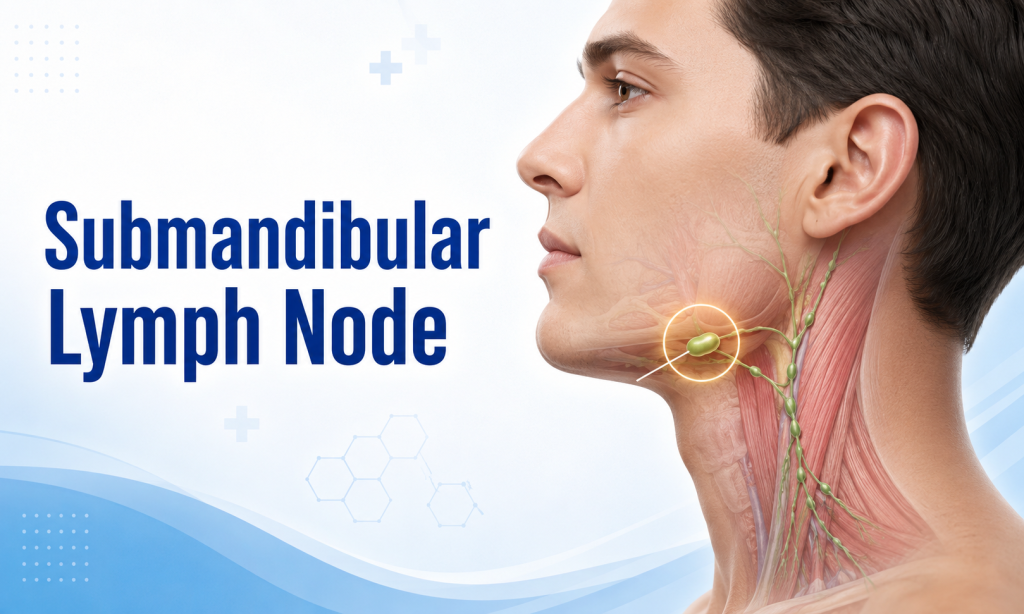
A practical diagnostic pathway for infections, dental causes, salivary gland problems, persistent neck masses, testing, and treatment in 2026.
Finding a lump beneath the jaw can be unsettling. A swollen submandibular lymph node often means the immune system is reacting to a nearby problem, such as a sore throat, cold, skin irritation, or dental infection. The location matters because these nodes drain areas of the mouth, lower face, tongue, gums, and nearby tissues.
Still, not every lump in this area is a lymph node. The submandibular salivary gland sits nearby and can enlarge when a duct is blocked by a stone or when the gland becomes infected. The most useful first step is therefore not guessing the diagnosis, but following the clues: where the lump sits, whether it hurts, how quickly it appeared, what other symptoms are present, and whether it is shrinking or persisting.
| KEY TAKEAWAYS
· Submandibular nodes commonly enlarge because of infections in the teeth, gums, throat, mouth, or nearby skin. · A tender, movable node that appears with an obvious infection is usually less concerning than a hard, fixed, painless, or steadily enlarging mass. · Adults should not ignore a neck mass that persists without a clear infectious cause, especially when it lasts several weeks or comes with swallowing, voice, mouth, or weight-loss symptoms. · Children often develop reactive neck nodes during routine infections, but nodes larger than about 2 centimeters, matted nodes, or persistent unexplained swelling deserve evaluation. · Treatment targets the underlying cause. Antibiotics, steroids, or repeated squeezing should not be used as do-it-yourself treatments for an unexplained lump. |
First question: Is the lump actually a lymph node?
The term submandibular means “under the lower jaw.” Several structures share this small space, so a lump can come from different tissues. A clinician distinguishes them by location, movement, consistency, and what makes the swelling change.
| What it may be | Clues that point in that direction |
| Reactive lymph node | Usually a small oval or bean-shaped lump. It may be tender and mobile, especially during a cold, sore throat, dental problem, or skin infection. |
| Submandibular salivary gland or stone | Often feels broader or deeper than a node. Pain or swelling may increase around meals, when saliva production rises. |
| Dental abscess or jaw infection | May occur with toothache, gum swelling, bad taste, facial swelling, fever, or pain when chewing. |
| Skin cyst | Often sits closer to the skin surface and may have a visible pore, redness, or a history of recurring inflammation. |
| Other neck mass | A persistent, firm, fixed, or enlarging lump may require imaging and tissue sampling to identify its origin. |
Why do submandibular lymph nodes swell?
Lymph nodes act as immune checkpoints. They filter lymphatic fluid and help immune cells recognize germs or abnormal cells. When tissue in the drainage area becomes inflamed, the nearby nodes may enlarge as immune activity increases. The swelling itself is a sign, not a disease.
The dental and mouth pathway
Teeth and gums are especially important when a node under the jaw becomes tender on one side. Tooth decay, a dental abscess, infected gums, recent dental procedures, mouth ulcers, and infections around a partially erupted wisdom tooth can all trigger nearby nodes. A dental source becomes more likely when there is tooth sensitivity, pain with biting, gum swelling, facial pressure, pus, a foul taste, or reduced ability to open the mouth.
The throat, nose, and skin pathway
Viral upper respiratory infections, strep throat, tonsillitis, influenza, and other infections can cause one or several cervical nodes to react. Cuts, acne, shaving irritation, or infected skin on the lower face may do the same. Direct infection of a lymph node, called lymphadenitis, is more likely when the node is very painful and the overlying skin becomes red, hot, or swollen. Fever may be present, and an abscess can occasionally form.
The bodywide pathway
When lymph nodes are enlarged in several regions, clinicians consider systemic infections and inflammatory conditions. Examples include infectious mononucleosis, cytomegalovirus, HIV, tuberculosis, cat-scratch disease, toxoplasmosis, autoimmune illnesses, and some medication reactions. Travel, animal exposure, recent vaccines, new prescriptions, immune status, and sexual history can all affect the diagnostic plan.
The less common but important pathway
Cancer is not the most common explanation for a submandibular lump, but persistent neck masses require appropriate attention. Lymphoma can begin in lymphatic tissue, while cancers of the mouth, tongue, throat, salivary gland, or other nearby structures may spread to cervical nodes. Risk rises with age and with exposures such as tobacco and heavy alcohol use, but serious causes can occur in people without those risk factors.
A 2025 review in American Family Physician recommends evaluating the location, size, texture, mobility, tenderness, duration, systemic symptoms, exposures, medications, and whether the swelling is localized or generalized. It also notes that persistent lymphadenopathy beyond four weeks or swelling accompanied by systemic symptoms may require laboratory testing and imaging.
What do the feel and timing of the node suggest?
| Finding | What it may mean |
| Tender and appeared quickly | Often fits an infection or inflammation, particularly when there is a sore throat, tooth problem, fever, or skin irritation. |
| Soft or rubbery and movable | Can occur with reactive nodes. “Movable” is reassuring only when the overall history also looks benign. |
| Hard, fixed, or matted | Needs medical evaluation because these features can occur with malignancy or granulomatous disease. |
| Painless and steadily enlarging | More concerning than a node that becomes tender during a clear infection and then shrinks. |
| Fluctuant, red, and hot | May indicate suppurative lymphadenitis or an abscess that needs prompt treatment. |
| Present in several body regions | Suggests a systemic process rather than a single local dental or throat problem. |
Important: Texture and tenderness cannot diagnose the cause on their own. A clinician considers the complete pattern and may use imaging or biopsy when needed.
When should you make an appointment?
Arrange a medical or dental evaluation when the lump has no obvious explanation, is getting larger, or does not begin to settle after the suspected infection improves. The threshold for evaluation should be lower in adults with a new persistent neck mass.
- The lump remains present for several weeks or keeps returning.
- It is hard, fixed, matted to nearby tissue, or clearly enlarging.
- It is larger than expected, especially around 2 centimeters or more in a child.
- There are drenching night sweats, unexplained fever, persistent fatigue, or unintentional weight loss.
- You have a mouth sore, tongue lesion, hoarseness, ear pain without an ear infection, difficulty swallowing, or a change in voice that does not resolve.
- You have ongoing tooth pain, gum swelling, facial swelling, or signs of a dental abscess.
- Nodes are enlarged in the armpits, groin, or several areas in addition to the neck.
The American Academy of Otolaryngology-Head and Neck Surgery guideline emphasizes prompt, accurate evaluation of adult neck masses when malignancy is possible, rather than allowing repeated empiric treatment to delay diagnosis.
When is swelling under the jaw urgent?
Seek urgent care the same day for rapidly worsening pain, high fever, spreading redness, pus, significant facial swelling, dehydration, or an inability to open the mouth normally. Go to an emergency department for trouble breathing, drooling with inability to swallow, severe neck stiffness, swelling that pushes the tongue upward, confusion, fainting, or other signs of a deep neck infection or airway problem.
What happens during the medical evaluation?
The workup usually follows a sequence rather than jumping immediately to biopsy. The purpose is to identify an obvious local cause while recognizing features that require faster investigation.
- History: The clinician asks when the lump appeared, whether it is changing, recent illnesses, dental symptoms, pain with meals, travel, animal contact, medication changes, vaccines, immune conditions, tobacco or alcohol exposure, and symptoms such as fever, night sweats, or weight loss.
- Focused examination: The mouth, teeth, gums, tongue, tonsils, skin, salivary glands, ears, and neck are examined. The clinician checks node size, tenderness, texture, mobility, and whether other lymph node regions are involved.
- Targeted tests: A complete blood count, inflammatory markers, throat testing, viral testing, tuberculosis testing, or other labs may be chosen based on the history. Not everyone needs the same panel.
- Imaging: Ultrasound is commonly the first imaging test for peripheral lymphadenopathy in children age 14 and younger. Adults with persistent or higher-risk neck lymphadenopathy may need contrast-enhanced CT or MRI.
- Tissue sampling: Fine-needle aspiration, core needle biopsy, or excisional biopsy may be used when imaging is suspicious, the cause remains unclear, or the node does not resolve as expected. Core biopsy can provide more tissue architecture than a simple aspiration.
The Merck Manual overview of lymphadenopathy notes that many people with newly identified localized nodes and no red flags can be observed for up to about four weeks, while persistent unexplained nodes, generalized swelling, or concerning features call for further testing. Observation is a clinical decision, not a reason to ignore changes.
How is a swollen submandibular lymph node treated?
There is no medication that treats “a swollen node” as a stand-alone diagnosis. Treatment is directed at the cause.
When the cause is viral
Supportive care may be enough for an uncomplicated viral illness. Rest, appropriate fluids, and over-the-counter pain or fever medication may help when safe for the individual. The node can remain noticeable for a while after the infection improves because immune tissue may shrink gradually.
When the cause is bacterial
Antibiotics are used when a clinician identifies or strongly suspects a bacterial infection, such as bacterial lymphadenitis, strep throat, or a dental infection. An abscess may require drainage. Antibiotics do not treat viral illness, lymphoma, salivary stones, or other nonbacterial causes, so taking leftover medication can delay the correct diagnosis.
When the cause is dental
Dental treatment may involve drainage, root canal therapy, extraction, periodontal care, or antibiotics when the infection has spread or systemic symptoms are present. Pain relief alone does not remove the source of an abscess. Facial swelling, fever, or difficulty swallowing requires prompt attention.
When the cause is a salivary stone
Management may include hydration, warm compresses, gentle gland massage, and measures that stimulate saliva, but only after a clinician confirms the likely problem and checks for infection. Recurrent obstruction, severe pain, or infection may require an ear, nose, and throat specialist or oral surgeon.
When the cause is inflammatory or malignant
Autoimmune disease, granulomatous disease, lymphoma, leukemia, and metastatic cancer require condition-specific treatment. Corticosteroids should generally not be started for unexplained lymphadenopathy before diagnosis because they can temporarily shrink lymphoma-related nodes and interfere with tissue interpretation.
What should you avoid doing at home?
- Do not repeatedly squeeze, dig at, or aggressively massage an unidentified lump.
- Do not start leftover antibiotics or someone else’s prescription.
- Do not take corticosteroids simply to make the node shrink before the cause is known.
- Do not assume that a painless lump is harmless because it does not hurt.
- Do not rely on size alone. Trend, texture, duration, symptoms, age, and location all matter.
How long can a reactive node stay enlarged?
A node caused by a routine infection may start to soften and shrink as the illness resolves, but it can remain palpable after other symptoms disappear. What matters is the direction of change. A node that is steadily getting smaller is different from one that is unchanged, enlarging, recurring, or becoming firmer. Persistent swelling beyond roughly four weeks, especially without a clear cause or with systemic symptoms, generally warrants reassessment.
Does age change the level of concern?
Yes. Children frequently develop reactive cervical nodes because their immune systems encounter many respiratory and throat infections. Ultrasound is often favored first when imaging is needed. Even so, a very large node, hard or matted nodes, prolonged unexplained swelling, supraclavicular nodes, or systemic symptoms should not be dismissed.
In adults, a persistent neck mass deserves more deliberate evaluation because the probability of malignancy increases with age. A new lump that lasts, enlarges, or appears without an obvious infection should be assessed rather than repeatedly treated as “swollen glands.”
Questions worth bringing to the appointment
- Does this feel like a lymph node, salivary gland, cyst, or another type of mass?
- Is there evidence of a dental, throat, skin, or salivary infection?
- What change should I expect, and by what date should it be smaller?
- Which symptoms would mean I need urgent care?
- Do I need ultrasound, CT, MRI, blood tests, dental imaging, or a biopsy?
- Should I see a dentist, primary care clinician, pediatrician, ENT specialist, hematologist, or oral surgeon?
The practical bottom line
Most swelling in a submandibular lymph node is reactive and linked to a nearby infection, particularly in the mouth, teeth, throat, or skin. Tenderness, mobility, a clear infectious trigger, and gradual improvement are generally reassuring features. They do not replace evaluation when the pattern is unusual.
A hard, fixed, painless, steadily enlarging, or persistent lump should be examined, as should swelling associated with night sweats, unexplained weight loss, mouth or throat symptoms, widespread nodes, or significant dental or facial infection. The right next step may be simple observation, dental care, laboratory testing, imaging, or tissue sampling. The goal is not to fear every lump, but to avoid overlooking one that is behaving differently from a routine reactive node.
| Medical note: This article is for general educational purposes and does not diagnose a neck lump or replace care from a licensed healthcare professional. Seek urgent help for breathing or swallowing difficulty, rapidly spreading swelling, or severe illness. |