
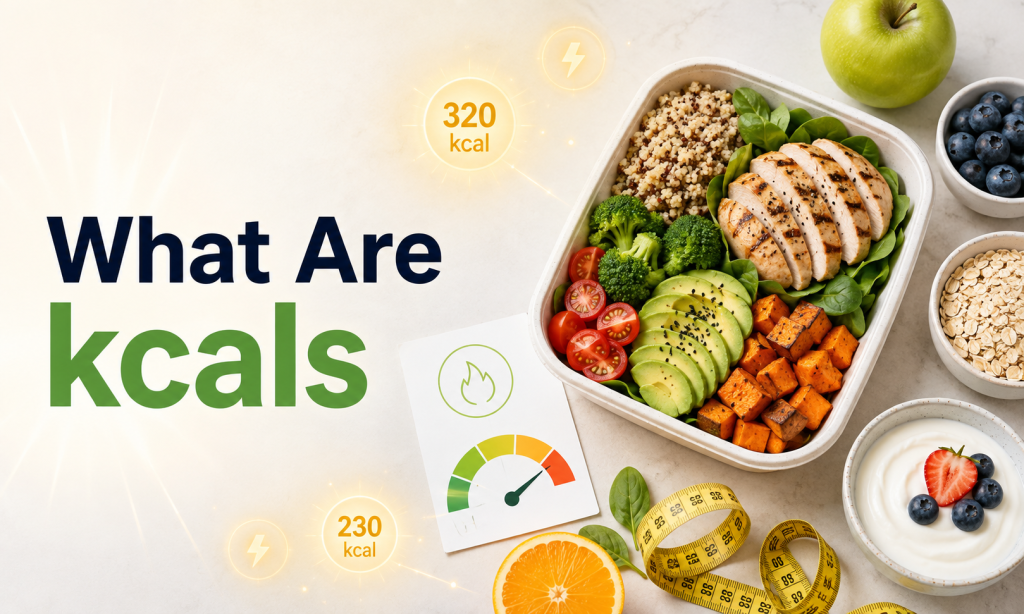
If you are wondering what are kcals, the simplest explanation is that if an app says 500 kcal and a U.S. food label says 500 Calories, they are telling you the same thing.
The word kcal can make nutrition look more technical than it really is. In everyday food and fitness language, one kilocalorie, written as 1 kcal, is the same amount of energy Americans usually call 1 Calorie with a capital C.
So a meal listed as 650 kcal contains the same food energy as a meal listed as 650 Calories on a U.S. Nutrition Facts label. You do not multiply the food-label number by 1,000. The 1,000-to-1 difference matters only when you compare a kilocalorie with the much smaller scientific unit called a calorie with a lowercase c.
That distinction explains why nutrition apps, international food packages, exercise machines, and U.S. labels can use different-looking terms while reporting the same practical energy amount.
| KEY TAKEAWAYS
· 1 kcal equals 1 food Calorie, also written as 1 Cal with a capital C. · 1 kcal equals 1,000 small scientific calories. · A U.S. Nutrition Facts label that says 200 Calories is effectively reporting 200 kcal. · Carbohydrate and protein generally provide about 4 kcal per gram, while fat provides about 9 kcal per gram. · The FDA uses 2,000 Calories per day as a general label-reference amount, not as a personalized prescription. · Your actual energy needs vary with age, body size, activity, life stage, health, and other individual factors. |
The 10-Second Decoder: kcal, Calorie, and calorie
| Term | Symbol | Where You See It | What It Means |
| 1 calorie | cal | Small scientific unit | Energy needed to raise about 1 gram of water by 1°C |
| 1 kilocalorie | kcal | Food-energy unit | 1,000 small calories |
| 1 Calorie | Cal | U.S. nutrition term | The same energy as 1 kcal |
In normal nutrition conversation, people usually write ‘calories’ with a lowercase c even when they technically mean kilocalories. That shortcut is so common that it rarely causes a practical problem. The confusion appears mostly when someone notices kcal on an app or international label and assumes it must be a different number.
Why Does a Kilocalorie Equal 1,000 Calories?
The prefix kilo means 1,000. A kilometer is 1,000 meters, and a kilogram is 1,000 grams. The same logic applies to energy units: one kilocalorie is 1,000 calories.
A small calorie is traditionally defined in terms of the energy required to raise the temperature of a small amount of water. A kilocalorie scales that energy up by 1,000. In modern scientific work, energy is usually expressed in joules rather than calories.
The conversion is straightforward: 1 small calorie equals 4.184 joules, so 1 kilocalorie equals 4,184 joules, or 4.184 kilojoules.
That is why labels in some countries show both kcal and kJ. For example, 250 kcal is about 1,046 kJ.
Why Do U.S. Food Labels Say Calories Instead of kcal?
The FDA Nutrition Facts Label guidance uses the word Calories for the energy in a serving of food or beverage. In this context, the number is a kilocalorie value even though the label does not print kcal next to it.
If a cereal label says 140 Calories per serving, that means 140 kcal. If a European nutrition app shows the same serving as 140 kcal, the energy amount has not changed.
The FDA also emphasizes serving size because calorie information is usually listed per serving. If a package contains two servings and you eat the whole package, you generally consume twice the Calories shown for one serving.
Where Do Kcals in Food Come From?
Food energy comes mainly from carbohydrate, protein, and fat. Alcohol also contributes energy.
For ordinary nutrition calculations, the familiar Atwater factors are:
| Macronutrient | Approximate Energy |
| Carbohydrate | About 4 kcal per gram |
| Protein | About 4 kcal per gram |
| Fat | About 9 kcal per gram |
The USDA’s FoodData Central reports food energy in kcal and explains that many energy values are calculated using Atwater factors. This is one reason a food’s calorie total can often be estimated from its grams of carbohydrate, fat, and protein.
For example, imagine a food containing 20 grams of carbohydrate, 10 grams of protein, and 5 grams of fat. A rough calculation would be 80 kcal from carbohydrate, 40 kcal from protein, and 45 kcal from fat, for about 165 kcal total.
Real labels can differ slightly from a simple calculation because food composition, fiber, sugar alcohols, specialized factors, laboratory methods, and FDA rounding rules can affect the displayed number.
If My Fitness Watch Says I Burned 400 Calories, Is That 400 kcal?
Yes. In everyday fitness language, a device reporting 400 calories burned is effectively reporting about 400 kcal of energy expenditure.
The harder question is whether the estimate is accurate. Watches and exercise machines infer calorie burn from inputs such as heart rate, movement, age, body size, workout type, and proprietary algorithms. They do not directly measure every calorie your body uses.
Treat workout calorie numbers as estimates rather than permission to replace every displayed calorie with extra food. Two devices can produce different numbers for the same session, and exercise energy expenditure varies between people.
Does 2,000 kcal Mean Everyone Should Eat 2,000 Calories?
No. The 2,000-Calorie figure on U.S. labels is a reference amount used to make nutrition information easier to compare.
The FDA notes that an individual’s needs can be higher or lower depending on factors including age, sex, height, weight, and physical activity. Pregnancy, breastfeeding, growth, illness, training volume, and weight-management goals can also change energy needs.
The current U.S. Dietary Guidelines for Americans, 2025-2030, were released in 2026. They emphasize overall eating patterns and nutrient-rich food choices rather than treating one calorie level as correct for everyone.
For current federal nutrition guidance, see the Dietary Guidelines for Americans. Personalized calorie targets are better estimated from individual characteristics than copied from the 2,000-Calorie label reference.
Why Two Foods With the Same Kcals Can Affect You Differently
Calories measure energy, not overall nutritional quality.
A 250-kcal snack could be a combination of fruit, yogurt, and nuts, or it could be a sugary beverage and candy. The energy total may be similar, but the foods can differ greatly in protein, fiber, vitamins, minerals, added sugars, saturated fat, volume, and how filling they feel.
Protein and fiber often contribute to fullness. Foods with water and fiber can provide more volume for the same calorie total. Highly energy-dense foods can pack many kcal into a small portion.
This is why calorie awareness can be useful without making calories the only thing you consider. A better label-reading approach is to look at serving size, Calories, protein, fiber, added sugars, saturated fat, sodium, and the ingredient list together.
Kcal vs kJ: What If the Label Uses Kilojoules?
Kilojoules measure the same thing, energy, using the international SI system.
A useful conversion is:
1 kcal = 4.184 kJ
So 100 kcal is about 418 kJ, and 500 kcal is about 2,092 kJ.
You usually do not need to convert manually. Many labels outside the United States list both values, and nutrition apps often let you choose a preferred energy unit.
Common Kcal Mistakes to Avoid
Mistake 1: Multiplying Food-Label Calories by 1,000
If a U.S. label says 300 Calories, it already means about 300 kcal. You should not interpret it as 300 small scientific calories or convert it to 300,000 food Calories.
Mistake 2: Treating the Serving Size as a Recommendation
Serving size tells you the amount used for the nutrition calculation. The FDA specifically notes that serving size reflects how much people typically consume, not how much an individual should necessarily eat.
Mistake 3: Assuming Low-Calorie Automatically Means Nutritious
A low-kcal item can still be high in sodium or low in fiber, protein, vitamins, and minerals. Likewise, calorie-dense foods such as nuts can provide useful nutrients. Context and portion size matter.
Mistake 4: Treating Exercise Calories as Exact
Wearable and machine estimates are useful for trends, but they are not laboratory measurements. Avoid building a precise eating plan around one workout number.
Mistake 5: Using a Fixed Calorie Formula for Weight Change
Weight change is influenced by energy intake and expenditure, but the body adapts over time. Metabolism, body composition, water balance, activity, appetite, and adherence all affect real-world results.
Simple rules such as assuming a fixed calorie deficit will always produce the same amount of weight loss can be useful as rough illustrations, but they should not be treated as precise biological predictions.
How Should You Use Kcals When Reading a Nutrition Label?
A simple five-step scan works well:
- Check the serving size first.
- Look at Calories, which are equivalent to kcal.
- Decide how many servings you are actually eating.
- Check protein, fiber, added sugars, saturated fat, and sodium.
- Compare similar foods using the same serving amount whenever possible.
Suppose a package lists 220 Calories per serving and contains three servings. Eating one serving gives you 220 kcal. Eating half the package gives you about 330 kcal. Eating the whole package gives you 660 kcal.
That simple serving-size check prevents more confusion than almost any advanced calorie calculation.
Frequently Asked Questions
Is 1 kcal the same as 1 Calorie?
Yes. In nutrition, 1 kcal equals 1 Calorie with a capital C. This is the unit used for food energy on U.S. labels, even though labels usually print the word Calories rather than kcal.
Is 100 kcal the same as 100 calories on a food label?
Yes. A U.S. food label showing 100 Calories is reporting approximately the same amount of food energy as 100 kcal.
How many small calories are in 1 kcal?
There are 1,000 small scientific calories in 1 kilocalorie.
How many joules are in 1 kcal?
One kilocalorie equals 4,184 joules, or 4.184 kilojoules.
Do kcal make you gain weight?
Kcal are simply a measure of energy. Consistently consuming more energy than your body uses can contribute to weight gain, while consistently consuming less can contribute to weight loss. Real body-weight changes are affected by many factors and are not perfectly predicted by one fixed formula.
Why does Europe use kcal?
Many food-labeling systems outside the United States display energy as kcal, often alongside kJ. U.S. labels usually use Calories, but the practical food-energy unit is the same.
Should I count kcal every day?
Not everyone needs to. Tracking can be useful for some goals, but meal quality, hunger and fullness, medical needs, activity, and sustainability matter too. People with specific nutrition or health concerns may benefit from individualized guidance from a registered dietitian or clinician.
The Bottom Line
Kcals are simply units of food energy. One kcal equals one food Calorie, so the numbers you see in a nutrition app, on an international food package, or on a U.S. Nutrition Facts label can usually be compared directly.
The technical difference only appears when you compare a kilocalorie with a small scientific calorie: 1 kcal equals 1,000 calories. For everyday eating, that distinction is mostly terminology.
The more useful skill is knowing what the number can and cannot tell you. Calories help describe energy intake, but they do not measure overall diet quality. Start with serving size, understand that Calories and kcal are equivalent in nutrition, and use the rest of the label to judge the food’s nutrient profile.
This article is for general educational purposes and is not individualized nutrition or medical advice. Nutrition guidance and labeling information were checked against current U.S. federal sources available in August 2026.